Kion Demos Physical AI at GTC
Kion presented two industrial applications of physical AI at the recent GTC 2026, which took place March 16-19 in San José, California.
The demonstrations focused on autonomous material handling in operational warehouse environments and on safety-certified human detection for automated trailer loading.
It was the next step of the strategic collaboration between Kion, NVIDIA, and Accenture, aimed at bringing AI and digital twins to the physical world in the supply chain, driving the integration of AI-driven perception, simulation, and fleet orchestration.
These lighthouse projects mark a transition from simulation-based development to deployment in real-world operations.
Kion uses NVIDIA’s Omniverse platform and the MEGA simulation engine as well as a physical AI-powered digital twin and systems architecture pioneered by Accenture to create digital twins of customer warehouses, enabling virtual commissioning before physical installation. This approach allows scenarios to be tested under variable conditions, including safety-critical situations.
“Our customers are facing increasing labor shortage and have a high need to increase operational efficiency. Kion solves this challenge with the use of intelligent automated mobile robots and AI-cameras in supply chain operations,” said Rob Smith, CEO of Kion Group AG.
“Our GXO pilot marks an important step forward in demonstrating how physical AI solutions deliver clear, tangible value for customers.”
Autonomous industrial truck at GXO
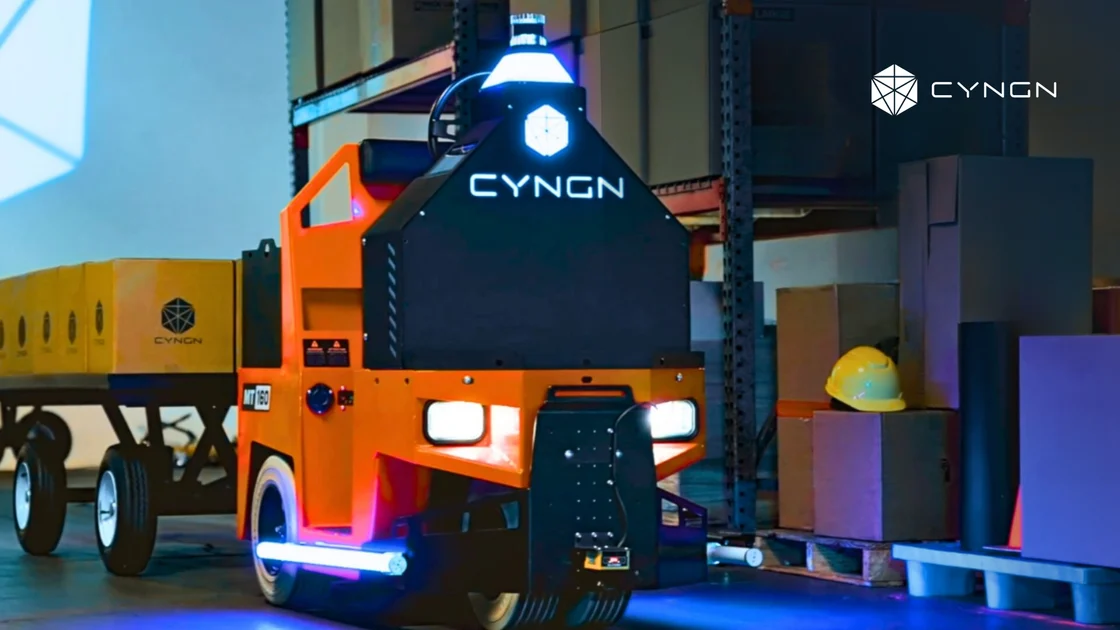
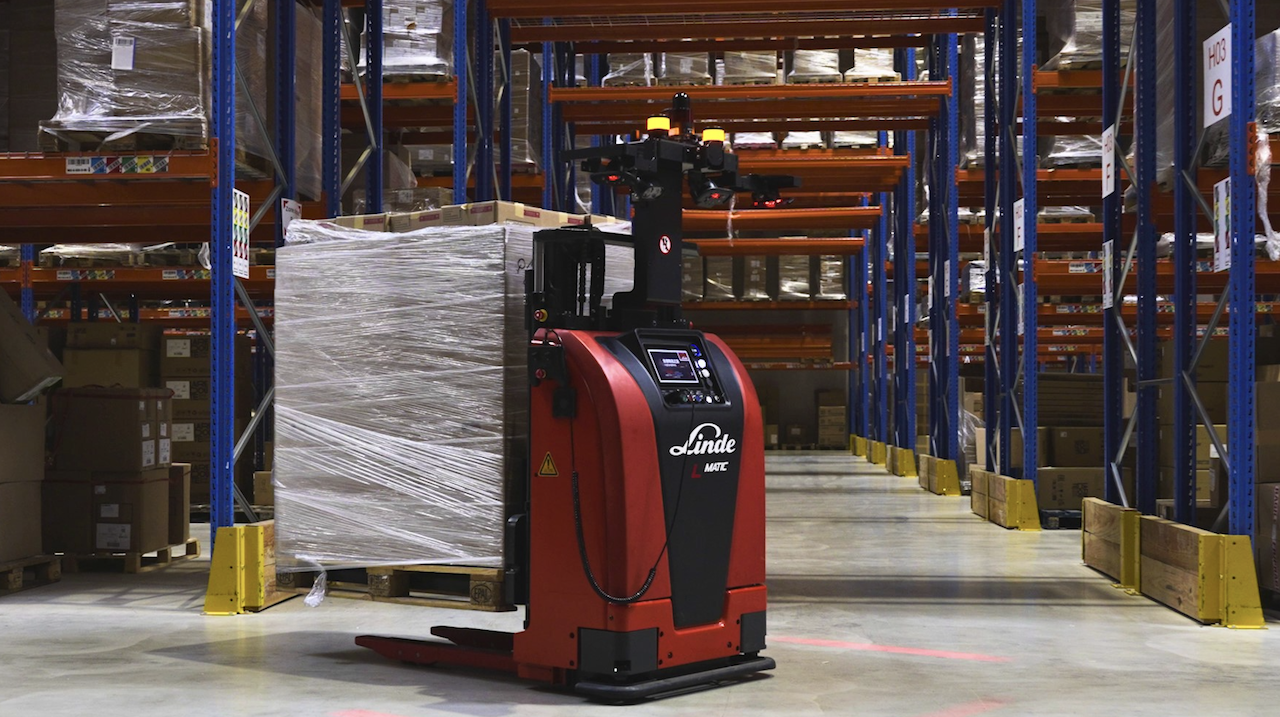
Kion has deployed its first AI-supported autonomous industrial truck at a GXO Logistics warehouse in Épinoy, France. GXO, the world’s largest pure-play contract logistics provider, is the leader in tech-enabled fulfillment managing outsourced supply chains, warehousing, and reverse logistics for leading brands across 27 countries. The site, which currently operates more than 200 manual trucks, serves as a pilot environment for Kion’s physical AI.
“We’re focused on turning advanced AI into tangible value across our operations and this pilot helps explore what’s possible for the future of supply chain,” said Patrick Kelleher, CEO of GXO Logistics.
Before deployment, the warehouse was mapped using spatial scanners and then converted into a digital twin. Now, the truck completes full end-to-end transport missions autonomously in a live warehouse. It detects pallets using AI-based ceiling and onboard cameras before transporting them to defined drop locations. Most importantly: it operates alongside warehouse personnel and manual forklifts — all without human intervention.
Safety certification for human detection
Kion is working with NVIDIA on a certification for a functional safety solution that relies on AI-based human detection in warehouse environments. The system uses NVIDIA’s Halos foundation model, which detects and localizes humans and industrial trucks, and is fine-tuned with Kion’s domain-specific data for intralogistics environments.
The application is designed for automated trailer loading, a use case demonstrated at CeMAT Shanghai in October 2025. Kion’s approach uses stationary cameras connected to an NVIDIA edge AI platform. A proof of concept at a live warehouse is planned for later this year.
The demonstrations focused on autonomous material handling in operational warehouse environments and on safety-certified human detection for automated trailer loading.
Synthetic data and edge case simulation
Training AI models for safety-critical applications requires exposure to rare but plausible scenarios. Kion generates synthetic training data within virtual environments to prepare systems for so-called long-tail situations: events that occur with very low probability but must still be handled correctly. The virtual warehouse environment allows these scenarios to be simulated without disrupting live operations or requiring physical staging.


About Post Author